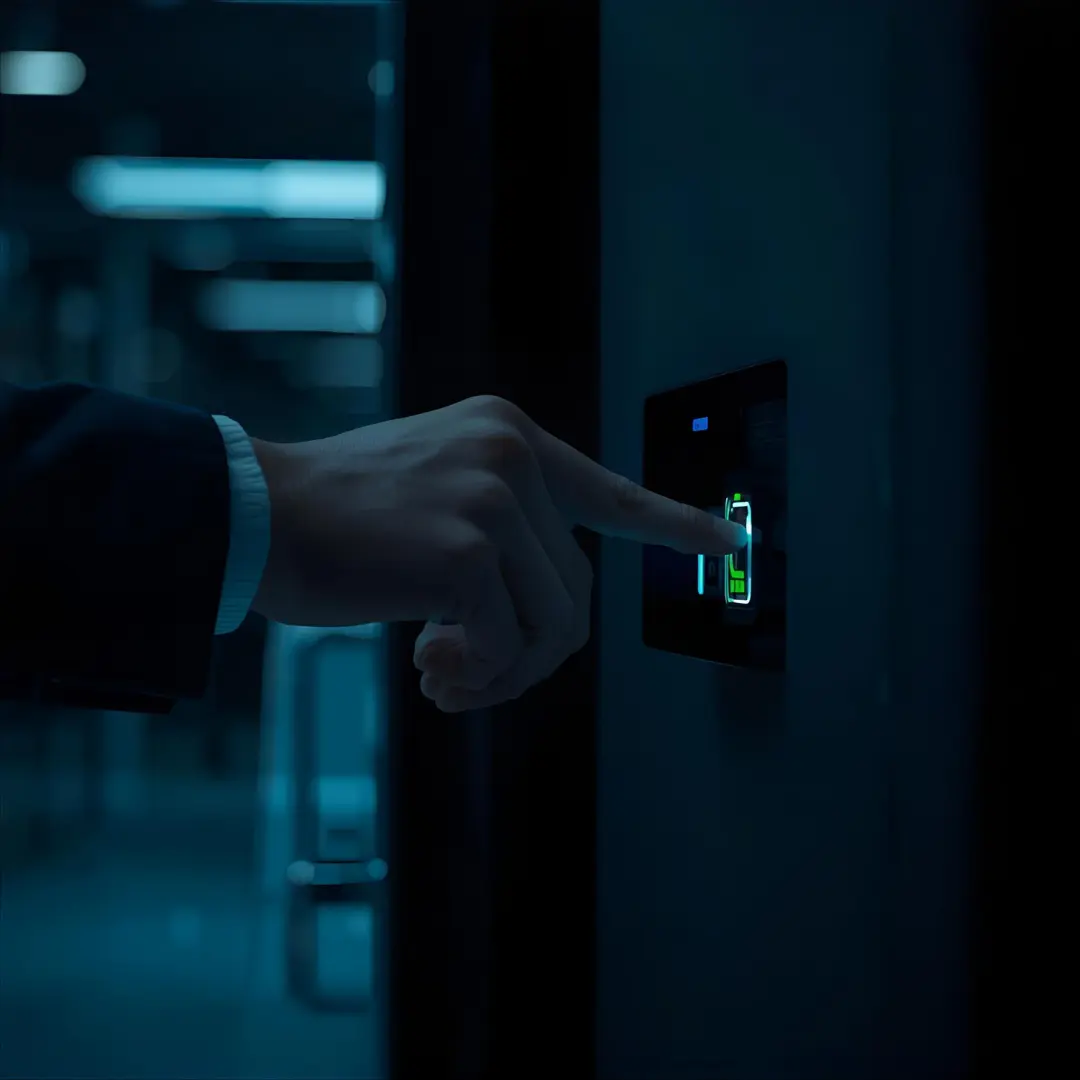
Hero image illustrating a physical pentesting scenario
Smaller hero image showing a physical pentesting action

100

+

Executed physical tests

PHYSICAL PENTEST

Real attacks. Real risks. Real evidence.

Firewalls do not stop footprints. An attacker with a hi-vis vest, toolbox, or charm often gets further than any malware. We test how attackers can physically access your building – before someone else proves it.

01

Why physical security fails

83% of all locations show critical gaps: uncontrolled access, weak processes, missing monitoring.

02

What attackers really do

Social engineering, tailgating, lockpicking, hardware drops – we simulate real threats.

03

Evidence, not theory

Our audit-ready reporting delivers priorities, actions, and a clear risk analysis for management and compliance.

Check your risk for free
Our services

Physical security testing – realistic attacks against your organization

We combine social engineering, physical attack techniques, and technical testing procedures to make real risks visible.

Social engineering testing

Social engineering attacks

Attackers pose as technicians, suppliers, or visitors – we test how far they would get.

Tailgating & physical intrusion test

Tailgating & physical intrusion

We check how easily attackers can enter through doors, side entrances, garages, or delivery areas.

Lockpicking & access control testing

Lockpicking & access testing

We test locking systems, access controls, and physical barriers like real attackers – fast, discreet, and documented.

Hardware drops and rogue device testing

Hardware drops & rogue devices

USB drops, rogue APs & more: We test whether manipulated hardware can be introduced unnoticed.

Camera & alarm system assessment

Camera & alarm system checks

We assess surveillance, response times, blind spots, and storage – including real test intrusions.

ISO- & audit-ready reporting

ISO- & audit-ready reporting

Evidence photos, video, risk ratings, and action lists – audit-proof for ISO 27001, KRITIS, NIS2, and DORA.

Regulations

Relevant regulations for physical security

Physical security controls are part of many requirements – we support you with audit-ready evidence.

KRITIS

Protection of critical infrastructure against physical attacks – we assess on-site access and security.

NIS 2

Extended requirements for network and information security – including physical control of IT locations.

DORA

For financial and technology companies: the physical resilience of systems becomes mandatory.

CER

The directive on the resilience of critical entities requires physical security measures along the entire value chain.

ISO 27001

The international standard for information security contains explicit requirements for physical barriers and controls.

TISAX

In the automotive sector, TISAX requires physical security measures at development and production sites.

73

%

uncontrolled access points

86

%

cameras without active monitoring

92

%

social engineering success

100

+

successful attacks

Physical pentest – a continuous cycle

From planning to remediation – iterative and controlled

Physical pentest
Continuous improvement
🖊️

1. Scoping & NDA

Clearly define targets, risk areas, and approvals.

2. Recon

Analyze buildings, processes, and visitor flows – without intrusion.

🔍

3. Test

Social engineering, tailgating, lockpicking – controlled and logged.

⚔️
📘

Evidence photos, risk ratings, and clear recommendations for action.

4. Reporting

5. Remediation

Quick fixes, awareness, and process updates – then a new cycle.

🔧

6. Review

Lessons learned, gap analysis, and planning of the next cycle.

🔄

Physical pentest – steps

🖊️
1. Scoping & NDA
Define objectives and approvals.
🔍
2. Recon
Analyze buildings and processes.
⚔️
3. Test
Social engineering and physical checks.
📘
4. Reporting
Risk analysis and actions.
🔧
5. Remediation
Quick fixes and process updates.
🔄
6. Review
Lessons learned and a new cycle.

🔄 The goal is to repeat the physical pentest over several years until we fail.

WHY US

Because attackers do not follow rules

Illustration of real attacks

Real attacks instead of checklists

We test like real attackers: social engineering, tailgating, lockpicking, hardware drops – all covered by an NDA.

Audit- and ISO-ready reporting

Audit- & ISO-ready reporting

Evidence photos, timestamps, risks, and actions – perfect for ISO 27001, KRITIS, NIS2, DORA, and internal audits.

Discrete and realistic tests

Discrete, quiet, realistic

Our engagements remain unobtrusive – but your results are clear, actionable, and provable.

Why choose us illustration for physical pentesting
FAQ's

Frequently Asked Questions & Technical Analysis on Physical Resilience

While a security walkthrough often just checks off a visual list, a Physical Pentest is an active, adversarial attack simulation process. We use the same tactics as criminal actors or corporate spies.

The process follows the OSSTMM standard: After a passive phase (reconnaissance), where we analyze shift schedules, supplier frequencies, and technical barriers like RFID reader types, we move into active infiltration attempts. We rely on a combination of Social Engineering (pretexting as a service provider), technical bypasses (e.g., overriding request-to-exit sensors), and hardware attacks (RFID cloning via Proxmark3). The goal isn't just to 'get in,' but to reach critical assets like server racks or executive offices to map out the actual business impact chain.

Knowing about a vulnerability is no protection against liability. On the contrary: documented but ignored risks can be interpreted as gross negligence in the event of a security breach. A professional physical pentest transforms your 'gut feeling' into reliable data.

We quantify the risk: How long does it take an attacker to reach the core switch? Which detection mechanisms fail? Using our risk rating (based on CVSS-like metrics for physical assets), we prioritize actions. Often, it's not expensive new fences but simple process changes at reception or technical adjustments to existing doors that eliminate 80% of the risks. A pentest provides you with the economic justification for security investments towards your management.

Safety and legality are our top priorities. Before every test, we create a 'Letter of Authorization' (Get-out-of-jail-free card), which defines the scope, authorized persons, and emergency contacts. Our pentesters carry this document and official IDs at all times.

Additionally, we clarify the Rules of Engagement (RoE) beforehand: Which areas are off-limits? What are the escalation levels? We work on the principle of minimal disruption. If an employee discovers us, the situation is immediately de-escalated and counted as a 'success of awareness.' It is never about shaming your team, but about identifying systemic vulnerabilities in the organization without compromising workplace peace or the physical integrity of individuals.

Physical security and IT security are inextricably linked. Many companies still rely on outdated RFID technologies like 125 kHz transponders (EM4102) or MIFARE Classic. These are technically broken and can be cloned within milliseconds using mobile devices like the Flipper Zero or hidden readers.

As part of the pentest, we check whether your access control systems are protected against replay attacks or card emulation. We demonstrate realistic scenarios where we gain unauthorized access by cloning an employee's badge. This is often an eye-opener for the IT department, as a compromised physical badge frequently provides a direct path into secured IT zones.

You will receive a comprehensive, audit-ready report. This includes a management summary for C-level executives as well as a detailed technical analysis for security officers. Every vulnerability found is documented with photo evidence and timestamps and categorized by criticality.

Especially regarding the NIS2 Directive and ISO 27001 (Annex A.7), our reporting provides the necessary proof of the effectiveness of your physical controls. We don't just list problems; we provide concrete remediation roadmaps. This allows you to prove to auditors that you are engaged in proactive risk management and adhering to the state of the art in securing your critical infrastructure.

Social engineering is the most effective lever in physical pentesting. We use psychological triggers like authority, helpfulness, or time pressure (pretexting). For example, our testers appear as external maintenance technicians, fire safety officers, or couriers.

We test your process stability: Does the reception ask for ID? Are visitors escorted? Are doors held open for the 'colleague' (tailgating)? This part of the test is essential to check the security awareness of your team under real conditions. The results are incorporated into recommendations for awareness training, as technical barriers are worthless if they can be bypassed by human factors.

A physical intruder has one goal: data. If we succeed in accessing server rooms, we often deploy rogue devices. These are modified microcomputers (e.g., LAN turtles or dropboxes) that we hide behind printers or under desks.

These devices build an encrypted reverse VPN tunnel to our lab, allowing us permanent access to your internal network—bypassing any firewall. We test how long this hardware remains undetected and whether your network access control (NAC/802.1X) blocks such devices. A physical pentest would be incomplete without checking for hardware implants, as this is the primary method for modern industrial espionage.

Absolutely. A realistic attacker chooses the time of least resistance. We often conduct tests during off-hours, at night, or on weekends to check the alertness of security guards and the effectiveness of intrusion detection systems (IDS) and video surveillance (CCTV).

In doing so, we analyze your reaction times: Does the alarm center respond? Does security arrive on-site in time? Are there blind spots in the surveillance? These flexible timing scenarios ensure that your physical protection measures work 24/7 and not just during core business hours when the building is busy anyway.


© AccessGranted X GmbH